








Europe faces the challenge of maintaining its economic strength in an increasingly multipolar world. Guidance comes from the Competitiveness Compass presented by the European Commission in January 2025, which builds on the analyses of the Draghi Report published 2024. It highlights three core priorities: closing innovation gaps, decarbonising the economy, and reducing strategic dependencies. In addition, improved financing conditions, a skilled workforce and tangible relief for businesses and public ad-ministration are intended to strengthen Europe as a location for investment and innovation.
So far, however, progress has been modest: only a small share of the proposed measures is currently being implemented. To accelerate matters, the Commission is relying on so-called omnibus packages designed to cut red tape and prevent new regulatory burdens. Yet many initiatives continue to stall – not least due to lengthy decision-making processes. Greater pragmatism and faster action are therefore seen as essential if Europe is to remain competitive internationally.
Early and clear prioritisation will also be crucial – for example in the negotiations surrounding the next Multiannual Financial Framework or a possible Competitiveness Fund. Beyond the size of the budget, the central issues are which technologies and measures Europe intends to support in the future and how only last-minute decisions on those issues can be avoided.
At the same time, the economic environment is undergoing profound change: trade, raw materials and technology standards are increasingly being used as geopolitical instruments. Complete European autarky is considered neither feasible nor desirable, but risk diversification and resilience are seen as viable strategies. Europe needs reliable partnerships and a clear understanding of which sectors should be regarded as strategic and therefore merit particular protection or support.
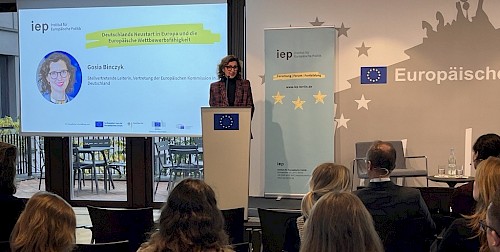
These issues were discussed by State Secretary Dr Thomas Steffen during the IEP Europe Talk moderated by Prof Dr Funda Tekin. The event was opened by Gosia Binczyk, Deputy Head of the European Commission’s Representation in Berlin, and was held with the support of the European Commission and the Federal Foreign Office.

Team & authors


 Share publication
