







The European Union is currently facing an enormous test of endurance. External economic and military threats require the rapid expansion of self-determined European defence and competitiveness. Achieving this requires an EU with a capability to act.
Russia's ongoing war of aggression against Ukraine, as well as threats and provocations from Moscow towards NATO and EU members, combined with the unpredictable development of the transatlantic partnership, require greater investment in the EU's defence capabilities. Initial steps in this direction are being taken, for example through the strengthened role of the European Defence Agency (EDA) in the joint development of military resources and the appointment of a Defence Commissioner. Nevertheless, NATO remains the central pillar of European defence and deterrence efforts. The EU's security policy initiatives tend to complement NATO's capabilities, for example through industrial policy measures. The German government in particular is a driving force behind cooperation between the EU and NATO.
Washington's increasing departure from the rules-based world order has also accelerated the diversification of European trade relations. European unity is proving to be an effective means of resolving trade conflicts on the one hand and gaining new trading partners on the other. A trade agreements has been successfully concluded with India. Another agreement with the Mercosur countries has formally been signed.. Further agreements, including with Australia and the Philippines, are in the pipeline. Germany is also striving to strengthen Europe's international competitiveness by reducing bureaucracy. The focus is to be less on regulation and more on business friendliness. This is also to be reflected in the negotiations on the new Multiannual Financial Framework, which is to be geared more towards investment in European defence capabilities and the promotion of innovation. On the initiative of the German government, the heads of state and government will discuss specific measures to strengthen competitiveness at a special EU summit.
In view of these challenges, the debate on the institutional future of the EU is becoming urgent. With a view to the desired enlargement of the Union, it is also important to be future-ready and able to take on enlargement. The European treaties offer the potential to simplify decision-making processes and reduce bureaucracy. Germany has a special responsibility to provide impetus for reform and to act as a mediating force between deepening and enlarging the European Union.
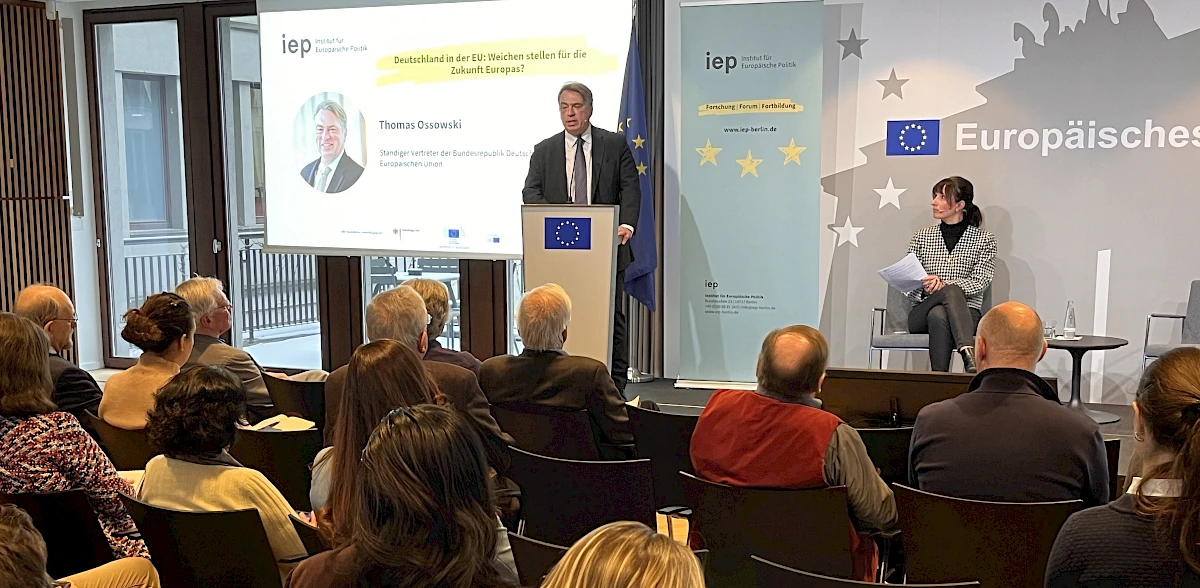
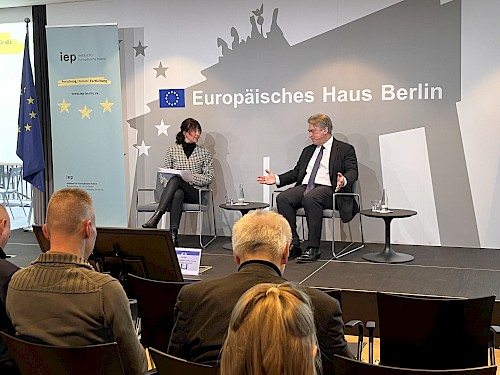
We discussed these and other topics at the IEP Europe Talk together with Thomas Ossowski, Permanent Representative of the Federal Republic of Germany to the European Union. Prof. Dr. Funda Tekin, Director of the IEP, welcomed the participants and moderated the discussion. The event was held with the kind support of the Federal Foreign Office.

Team & authors


 Share publication
